Strategy and business-model workshop for utility sales teams
Energy Sharing: from the legal framework to a robust business-model decision
Section 42c of the German Energy Industry Act (EnWG) provides the framework for sharing renewable electricity via the public distribution grid in Germany. Since 1 June 2026, sharing must be enabled within the balancing area of a distribution system operator. Whether a specific model is feasible depends on the statutory requirements and energy-market processes.
For sales teams, this alone does not create a marketable product.
For municipal utilities and energy suppliers · One in-person day · Around twelve participants
Outcome: a preliminary business-model decision and an individual roadmap for three, six and twelve months.
Participation requires statutory eligibility and suitable metering, balancing and operational processes. Complementary residual power supply remains necessary; reduced network charges or savings are not promised.
Content reviewed: 22 September 2026 · Section 42c EnWG (Germany) · Bundesnetzagentur: Energy Sharing
The strategic question for your utility
Which role should your utility take on in Energy Sharing – and under which economic and organisational conditions does it become a viable business model?
And this is not only about new revenue opportunities. If platform providers, direct marketers or other suppliers occupy the customer interface, existing customer relationships and residual power sales can shift away.
This is exactly where my one-day strategy and business-model workshop for utility sales teams comes in.
The sales team's decision logic
The workshop follows five consecutive decision questions:
- May we — and can we — implement Energy Sharing?
- For which customer groups does a convincing value proposition emerge?
- Which role should our utility take on?
- Is the business model economically and organisationally viable?
- Which pilot project should we pursue further?
One continuous practice case
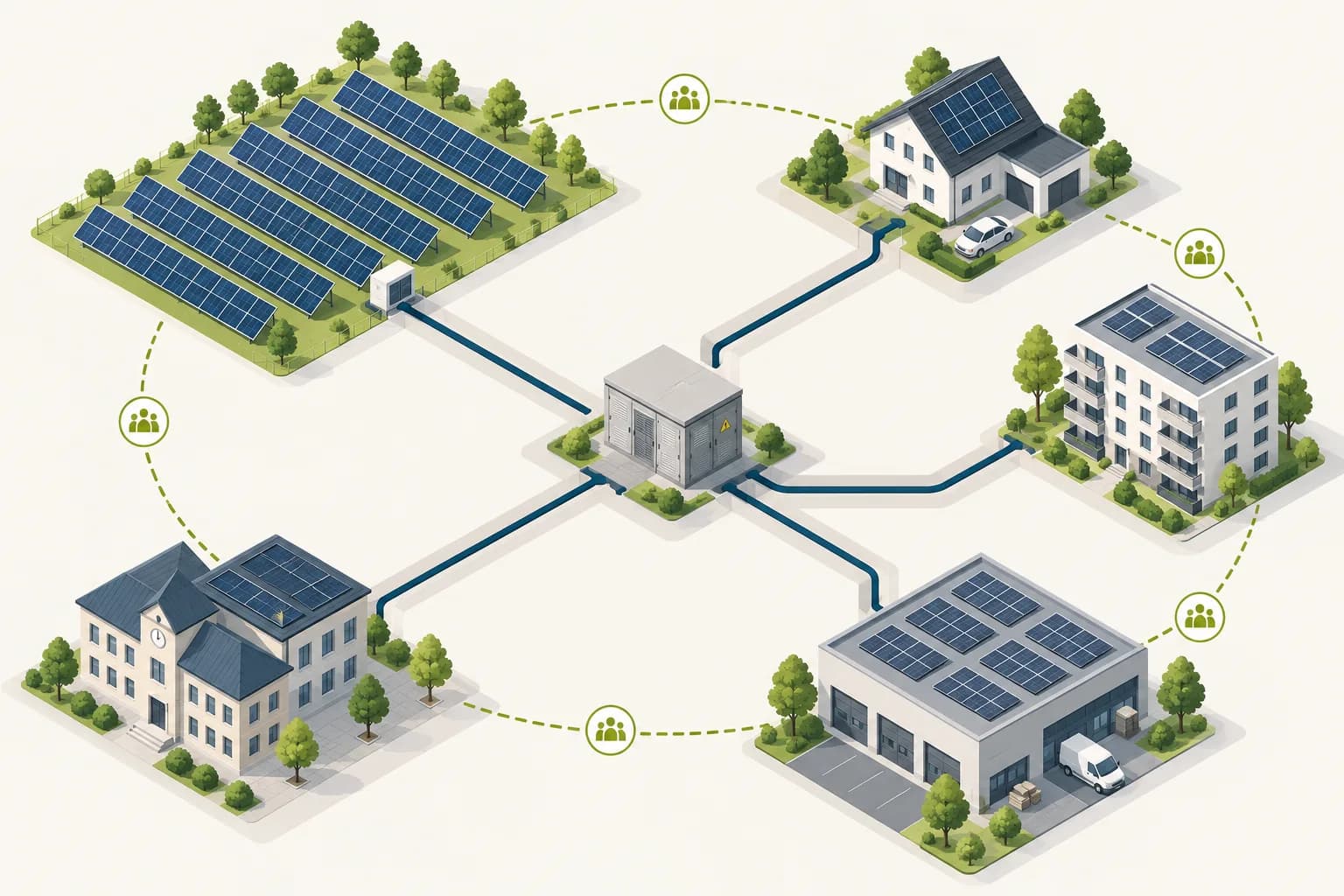
The starting point is an illustrative model case, not a completed client project, with variable PV plant sizes and different customer segments: residential customers, municipalities and municipal institutions, the housing sector, and small and medium-sized commercial customers.
The analysis focuses in particular on the service model described by the Bundesnetzagentur, the complementary residual power supply, direct marketing, quarter-hourly balancing and profitability.
What participants work out
Participants:
clarify the legal and operational prerequisites,
identify suitable customer groups and develop robust value propositions,
compare possible roles for their utility,
assess revenue sources, costs and risks as well as the impact on the customer interface and residual power sales,
determine the necessary cooperation, process and IT requirements,
select a suitable pilot project.
The result: an individual Energy Sharing roadmap
At the end of the day there is deliberately no fully calculated, implementation-ready product yet. The result is a well-founded preliminary business-model decision with an individual Energy Sharing roadmap:
- Which customer segment is suitable for getting started?
- Which role should the utility take on?
- Which shape of the business model should be pursued further?
- Which pilot project is a candidate?
- Which technical, economic and organisational questions still need to be clarified?
- Which steps are required within the next three, six and twelve months?
Audience and format
The workshop puts the energy-industry framework into context and supports strategic and commercial decision-making. It does not include legal advice or a case-specific legal review.
- Audience
- Experienced energy-industry professionals and executives from sales, product management and sales-related business development at municipal utilities and energy supply companies
- Group size
- A small in-person group of around twelve people
- Duration
- One day
- Format
- In-person workshop with a practice case, group work, evaluation matrices and a roadmap
Frequently asked questions about Energy Sharing
What is Energy Sharing under Section 42c EnWG?
Under the German Energy Industry Act (EnWG), Energy Sharing means the shared use of electricity from renewable sources. Unlike tenant electricity (Mieterstrom) or shared building supply, generation and consumption do not have to take place in the same building. The electricity is delivered via the public grid.
The shared volumes regularly cover only part of the electricity demand. An additional residual power supply contract is therefore required. Statutory eligibility, quarter-hourly measurement and balancing, and energy-market processes must be clarified. Not every plant or customer automatically qualifies.
Who is the workshop for?
The workshop is aimed at experienced energy-industry professionals and executives from sales, product management and sales-related business development at municipal utilities and energy supply companies. Work takes place in a small in-person group of around twelve people.
What is the outcome of the workshop?
The outcome is a well-founded preliminary business-model decision with an individual Energy Sharing roadmap. It describes the suitable customer segment, the utility's possible role, the business-model shape to pursue, a suitable pilot project and the next steps for three, six and twelve months.
A fully calculated, implementation-ready product is deliberately not the outcome of a single workshop day.
Does the workshop replace legal advice?
No. The workshop puts the energy-industry framework into context and supports strategic and commercial decisions. It does not replace legal advice or a case-specific legal review.
Which role should your utility take on in Energy Sharing?
If you want to do more than classify Energy Sharing legally — and develop a well-founded preliminary business-model decision and concrete next steps from it — let us talk about the right workshop.
Request the Energy Sharing workshop